Home / Essays / The Church: A Cosmic Temple
8 July 2021
The Church: A Cosmic Temple
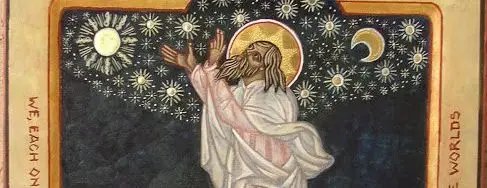
When was the Church established? Many would answer this question by pointing to Pentecost, where the Holy Spirit descended on the Apostles in tongues of fire, giving them the possibility of speaking in tongues and preaching about the incarnate Christ. Albeit a popular perception of the "inception of the Church," this model tends to omit certain essential patristic affirmations about who the Church is in relation to us and in relation to God.
St. Paul illustrates the Church as being the body of Christ (Ephesians 5:23). St. Paul then comments on the inclusion of a Christian within the body of Christ — or the Church — writing: "Therefore, if any one is in Christ, he is a new creation" (2 Corinthians 5:17). What does it mean for a human being — and humanity — to be a "new creation"? St. Athanasius of Alexandria, in the 4th century, explains the "new creation" in terms of salvation: "For [Christ] alone, being Word of the Father and above all, was in consequence both able to recreate all, and worthy to suffer on behalf of all..." For St. Athanasius, that which needed to be "recreated" was human nature, that it might conform to God as it once did.
For a "new creation" to exist — or for something to be "recreated" — there must be an "old creation." In Genesis, God creates: light, the sky, land, vegetation, the sun, moon and stars, fish and birds, animals, and then, at the very end, humans. For many of the early Church fathers and mothers, paradise is a type of the Church. God created a Church in the beginning, where there is:
1. light, His presence,
2. the sky, a roof,
3. land, the ground,
4. vegetation, a wall,
5. the sun, moon, and stars, revelations of God,
6. fish and birds, ornaments to the temple,
7. animals, sacrifices in the temple, and finally
8. humans, an image of the God of the temple.
In this way, God served creation as "high priest" (Hebrews 4:14) through His image, which He placed in the garden.
St. Hippolytus of Rome, a 2nd/3rd century saint, writes: "Eden is the new garden of abundance planted in the East, adorned with all sorts of trees, whereby we must understand the assembly of the righteous and the holy place where the Church was planted." In this way, the Church is not a novelty created after the chronological event of the incarnation; rather, she is eternal, existing from the beginning. As Origen, a 2nd-century Christian scholar, writes:
"You must please not think that she is called the Bride or the Church only from the time when the Saviour came in flesh: she is so called from the beginning of the human race and from the very foundation of the world."
The Church is, thus, not merely an entity created within the scope of time; rather, she is the body and bride of Christ, uniting man and God in an intimate relationship which unites eternity with time.
With this in perspective, becoming a "new creation," the Church is the point renewed to facilitate the intimate familiarity between God and humanity, which God made possible by the incarnation of His Son and the indwelling of His Holy Spirit. She cannot be cataphatically delineated to a certain place, time, or set of people; rather, she is cosmic — she is the world as conforming to God. In the words of the late Metropolitan Paulos Mar Gregorios, of the Syriac Orthodox Church:
"The ecclesia fills the gap between God and the World… The Church is the Pleroma [fullness] of Christ [in] that, in union with Christ, we fill the whole universe, visible, as well as invisible."
Even more, she is humanity as it approaches its likeness to God. One is in the Church by participation in God, by His Son, through His Holy Spirit. She is the recollection of God's image in each person, through whom God acts and serves the world. In short, in the words of Fr. Tadros Y. Malaty, "The Church is the spiritual body wherein mutual love between God and man is declared and practiced... it is 'life in Christ,' 'communion with the Father in the Son by the Holy Spirit.'\"